
2026 Best Permanent Magnet Air Compressor for Global Buyers
Choosing the right Permanent Magnet Air Compressor in 2026 requires more than comparing motor ratings or attractive efficiency claims. Global buyers need dependable performance, transparent specifications, and support that remains practical after installation. A compressor may look impressive in a catalog, yet perform differently under heat, dust, unstable voltage, or changing production demand.
This guide examines key buying factors for international factories, workshops, and processing facilities. It considers permanent magnet motor efficiency, variable-speed control, air delivery, pressure stability, noise, cooling design, maintenance access, and expected service life. Real operating details matter. A compressor running beside a packaging line should not create excessive noise. A machine serving pneumatic tools must maintain stable pressure during sudden demand increases. Energy savings also depend on duty cycles, leakage control, ambient temperature, and correct sizing.
Details matter. So does evidence.
Reliable suppliers should provide measurable performance data, clear warranty terms, installation guidance, and accessible replacement parts. Buyers should review recognized testing practices and applicable regional requirements before placing an order. Certification alone does not guarantee suitability. That assumption deserves scrutiny. Factory visits, application testing, and documented customer experience can reveal weaknesses that product brochures often hide.
The best choice is rarely the most powerful model. It is the compressor that matches actual air consumption, operating conditions, budget, and long-term maintenance capability. This 2026 overview offers a practical framework for comparing global options with greater confidence. Some efficiency figures may change in real conditions, and that limitation should be acknowledged. A careful buyer measures before committing.
What Is a Permanent Magnet Air Compressor?
What Is a Permanent Magnet Air Compressor?
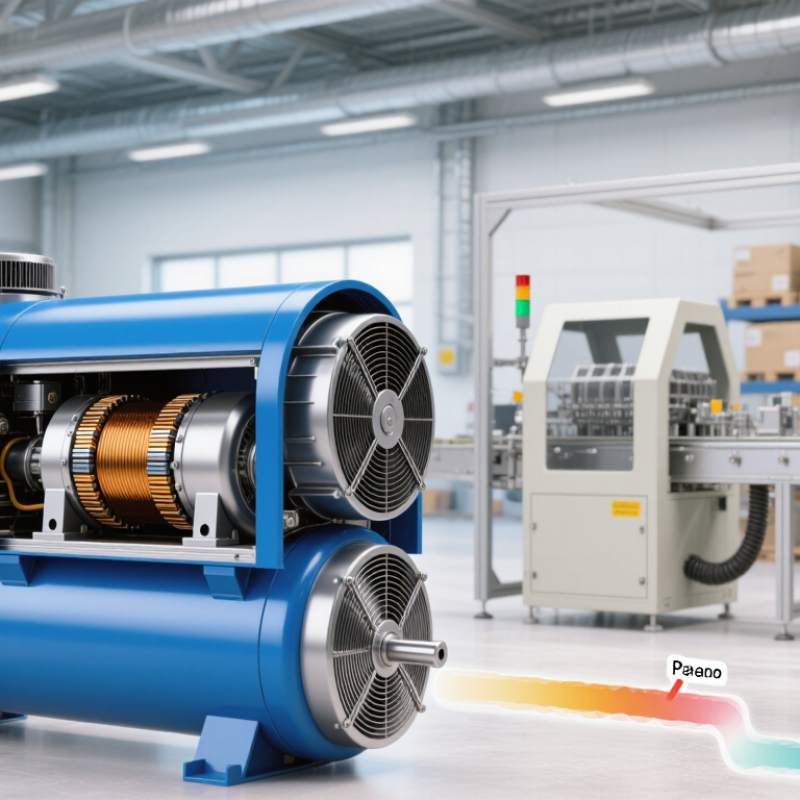
A permanent magnet air compressor uses a motor with embedded permanent magnets. Unlike a conventional induction motor, it does not rely on continuous rotor slip to create torque. This design can reduce electrical losses, especially during partial-load operation. Most models pair the motor with a variable-speed drive, adjusting rotation to match changing air demand. The result is less unloading, fewer pressure swings, and potentially lower energy use. The motor is permanent magnet; the compressor may still be oil-injected or oil-free.
The U.S. Department of Energy reports that compressed-air systems commonly consume 10–15% of industrial electricity, and inefficient plants may reach 30%. The International Energy Agency also identifies motor-driven equipment as a major industrial electricity load. These figures explain the market interest. Still, efficiency claims need careful testing. The label can mislead.
Buyers should review ISO 1217 performance data, specific power, input voltage, ambient-temperature limits, and service requirements. Ask for measured performance at several load points, not only the best rating. A permanent magnet motor may perform poorly if cooling is weak, controls are badly tuned, or demand changes sharply. Dusty workshops reveal problems quickly. So do hot coastal facilities. In my experience, the cheapest electricity estimate often ignores maintenance, standby losses, and replacement electronics. That omission deserves a second look.
A permanent magnet air compressor uses a permanent-magnet synchronous motor to drive the compressor element. Compared with a conventional induction-motor system, the motor can maintain high efficiency across a wider operating range, especially when combined with variable-speed drive control. The figures below are representative engineering ranges for commonly available industrial configurations; actual performance depends on pressure, cooling method, air quality, installation conditions, and testing standards.
| Configuration | Typical Motor Rating | Typical Working Pressure | Approximate Free Air Delivery | Motor Efficiency | Typical Specific Power | Noise Range | Common Applications | Main Selection Advantage |
|---|---|---|---|---|---|---|---|---|
| Compact PM screw compressor | 7.5–22 kW | 7–13 bar(g) | 0.8–3.5 m³/min | IE4–IE5 class motor performance is commonly available | Approximately 5.5–7.0 kW per m³/min at about 7 bar(g) | 58–70 dB(A) | Workshops, vehicle maintenance, small manufacturing lines, and general plant air | Small footprint, good part-load efficiency, and lower starting current than many fixed-speed systems |
| Medium PM screw compressor | 30–75 kW | 7–13 bar(g) | 4.0–12.0 m³/min | High motor efficiency with variable-speed operation | Approximately 5.2–6.5 kW per m³/min at about 7 bar(g) | 62–75 dB(A) | Machining, electronics assembly, packaging, textiles, and food-processing utilities | Strong balance between investment cost, energy consumption, and output capacity |
| Large PM screw compressor | 90–250 kW | 7–16 bar(g) | 14–42 m³/min | High efficiency when correctly matched to demand | Approximately 5.0–6.2 kW per m³/min at about 7 bar(g) | 68–82 dB(A) | Automotive plants, large factories, centralized utility systems, and continuous production | Lower lifecycle energy cost in plants with long operating hours and variable air demand |
| Oil-injected PM screw compressor | 7.5–250 kW | 7–16 bar(g) | 0.8–42 m³/min | High motor efficiency; package efficiency depends on separator and cooling design | Commonly optimized for general industrial compressed air | 58–82 dB(A) | General manufacturing, construction equipment, metalworking, and plant utilities | High volumetric efficiency and broad availability across industrial capacity ranges |
| Oil-free PM compressor | 15–250 kW, depending on compressor technology | 7–10 bar(g) for many two-stage applications | Approximately 1.5–42 m³/min | Motor efficiency is high; total package efficiency varies by compression stages and cooling | Usually higher than oil-injected systems at the same pressure because oil is not used for sealing and cooling | 65–85 dB(A) | Pharmaceuticals, medical air, semiconductor production, food contact processes, and sensitive instrumentation | Removes oil from the compression chamber; certification and air-quality verification remain essential |
| Low-pressure PM blower or compressor | 5.5–160 kW | 0.3–4 bar(g) | Approximately 2–30 m³/min | High efficiency is achievable at stable operating points | Application-specific; do not compare directly with 7 bar(g) compressor ratings | 60–80 dB(A) | Wastewater aeration, pneumatic conveying, paper production, and air-knife systems | Efficient solution when the process needs high flow at low pressure rather than standard plant air |
| High-pressure PM compressor package | 30–250 kW, often arranged in multiple stages | 20–40 bar(g) or higher, depending on design | Approximately 1–12 m³/min | High motor efficiency, but compression-stage efficiency becomes the main energy factor | Typically much higher than standard 7 bar(g) service because discharge pressure is substantially higher | 70–88 dB(A) | PET bottle production, pressure testing, specialized process air, and gas boosting | Provides controlled high-pressure air while allowing speed adjustment to match demand |