
What Is a Battery Cooler and How Does It Work?
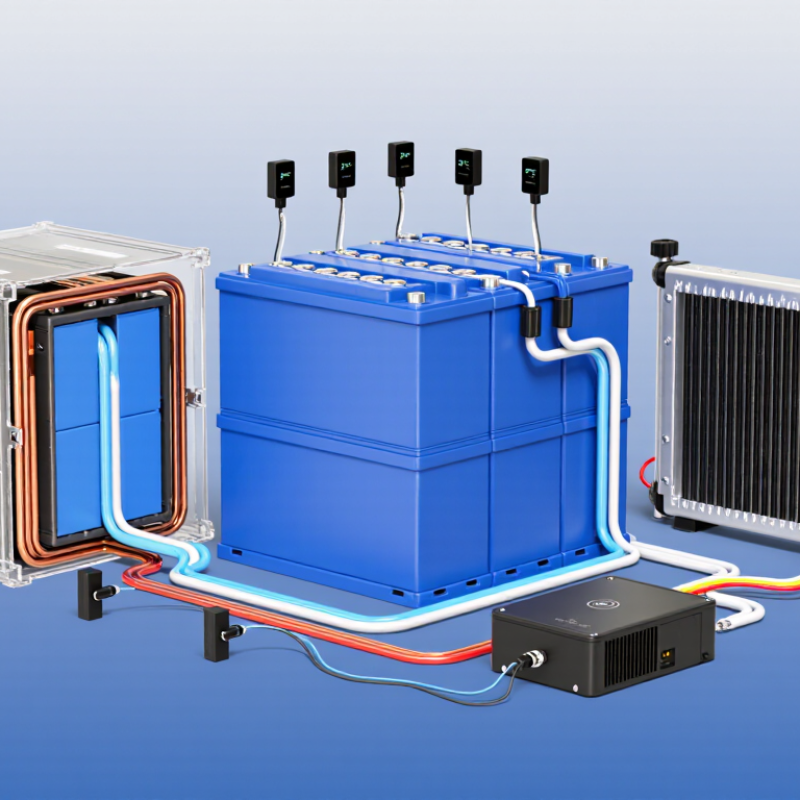
A Battery Cooler is a thermal-management system that helps keep battery cells within a suitable operating temperature range. It may use moving air, liquid coolant, or another heat-transfer method. In an electric vehicle, for example, coolant can flow through narrow channels beside battery modules, carrying heat toward a radiator or chiller. Small temperature differences matter. One overheated section can age faster than its neighbors.
Battery researcher Jeff Dahn’s work highlights how operating conditions affect battery aging. A careful paraphrase of that principle is: “Managing temperature helps protect battery performance over time.” This is not a direct quotation. It captures why a Battery Cooler does more than lower temperature: it can also help limit uneven heating and support more consistent charging and power delivery. Sensors and control software typically monitor conditions and adjust cooling as needed.
There is a catch. Cooling cannot fix every battery problem, and colder is not always better. The right temperature depends on cell chemistry, design, workload, and ambient conditions. A system that cools aggressively may use extra energy; one that responds too slowly may let heat build up. That sounds simple. In practice, the details matter. This guide explains what a Battery Cooler is, how its main parts work, and what to consider when comparing cooling approaches. It also looks at limitations, because a clear understanding is more useful than a promise of perfect protection.
What Is a Battery Cooler?
A battery cooler is a thermal-management system that removes excess heat from a battery and helps keep its cells within a suitable operating range. In electric vehicles, it may use air, liquid coolant, or refrigerant. A liquid system typically moves coolant through narrow channels beside or beneath the cells, much like a radiator serving a tightly packed row of components. Sensors monitor temperatures, and controls adjust cooling as the battery charges, discharges, or sits in hot weather. Not just a fan.
The goal is not simply to make a battery cold. It is to limit temperature differences between cells and avoid prolonged exposure to heat, which can accelerate ageing. The International Energy Agency’s Global EV Outlook 2024 reports that electric-car battery demand reached about 750 GWh in 2023, roughly 40% higher than in 2022. That growth makes reliable thermal management increasingly important across large battery packs. A cooler’s actual design depends on cell chemistry, pack layout, charging power, and climate; one solution does not fit every vehicle. That definition is a little incomplete, too: some systems also warm batteries in cold conditions, so “thermal management” is often more precise than “cooler.”
What Is a Battery Cooler and How Does It Work? - What Is a Battery Cooler?
| Cooling approach | How it works | Main components | Typical advantages | Important considerations | Common applications |
|---|---|---|---|---|---|
| Forced-air cooling | A fan moves air across or through the battery pack, carrying heat away from the cells. The air may come from the surrounding environment or the vehicle cabin. | Fan or blower, air ducts, vents, temperature sensors, and control electronics. | Relatively simple and lightweight; does not require liquid coolant lines inside the pack. | Air transfers heat less effectively than liquid, so performance can be limited in high-load conditions. Airflow should be distributed evenly to reduce cell temperature differences. | Small battery packs, low-power equipment, and some hybrid or electric vehicles. |
| Liquid cooling | A pump circulates coolant through channels or plates near the cells. The heated coolant passes through a Heat Exchanger, where heat is released to the surrounding air or another cooling circuit. | Coolant passages or cold plates, pump, hoses, heat exchanger, valves, sensors, and controller. | Can remove heat efficiently and help maintain more even temperatures across a high-capacity pack. | Adds parts, weight, and system complexity. The circuit must be designed to prevent leaks and manage coolant flow appropriately. | Many modern electric vehicles, energy-storage systems, and other high-power battery applications. |
| Refrigerant-based cooling | A refrigeration cycle removes heat from the battery, either through a dedicated heat exchanger or by chilling a separate coolant loop. The refrigerant absorbs heat as it evaporates and releases it elsewhere in the system. | Compressor, refrigerant lines, evaporator or chiller, condenser, expansion device, sensors, and controls. | Can provide active cooling when the battery is hotter than the surrounding air and can support temperature control in demanding conditions. | More complex than passive or fan-based cooling and uses energy to operate. System design must account for refrigerant safety and efficient control. | Electric vehicles and other systems that need active battery temperature management. |
| Phase-change material cooling | A material near the cells absorbs heat as it changes phase, commonly from solid to liquid. This stores heat temporarily and can slow the battery's temperature rise. | Phase-change material, containment structure, and heat-spreading surfaces; some designs combine it with active cooling. | Can reduce short-term temperature spikes without a continuously running pump or fan. | The material has finite heat-storage capacity and must release stored heat before it can absorb more. It is not, by itself, a continuous heat-removal system. | Battery modules and systems where passive buffering is useful, often alongside another cooling method. |
| Combined thermal management | Sensors monitor battery temperatures, and a controller adjusts fans, pumps, valves, or refrigeration equipment. Some systems also use the same thermal loop to warm a cold battery. | Temperature sensors, controller, cooling hardware, coolant circuits, and—where fitted—heating elements or heat pumps. | Can respond to changing operating conditions and help keep cells within the temperature limits specified for the battery. | Control strategy and sensor placement matter. Temperature limits and preferred operating conditions vary by cell chemistry and system design. | Battery packs that experience wide changes in load, ambient temperature, or charging conditions. |
A battery cooler is a component or system that helps remove excess heat from battery cells. By managing heat and temperature differences, it supports reliable operation; the required cooling method depends on the battery chemistry, pack design, power level, and operating environment.