
Choosing an EVA Shoe Mould in 2026 requires more than comparing prices or catalogue photographs. The mould must match the foam formula, target density, expansion ratio, and production rhythm. A beautiful sample can still hide uneven cell structure, flashing, or difficult demoulding.
Industry data shows why this decision matters. The World Footwear Yearbook 2024 reported approximately 23.9 billion pairs of footwear were produced globally in 2023, with Asia supplying most of the volume. Meanwhile, Grand View Research identifies footwear as a major application for ethylene-vinyl acetate, supported by its light weight, cushioning, and flexibility. These figures suggest strong demand, but they do not guarantee that every mould design will perform equally well.
Small details decide the result. Check cavity balance, vent placement, cooling-channel layout, aluminium or steel grade, surface treatment, and dimensional tolerances. Ask whether the supplier has tested the mould with your exact EVA compound. Request trial samples, density readings, hardness results, and cycle-time records. The World Footwear Yearbook offers useful market context, yet it cannot replace factory-level validation. That limitation matters.
A reliable supplier should explain shrinkage compensation clearly and provide maintenance guidance. The mould should also support repeatable production, not only one successful trial. In practice, buyers sometimes focus too heavily on the lowest quotation. That can be a costly mistake. A cheaper mould may increase trimming work, reject rates, energy use, and downtime. The best choice balances engineering accuracy, service capability, delivery stability, and total operating cost. Still, no recommendation is universal; compound behavior, machine pressure, and local production conditions can change the outcome.
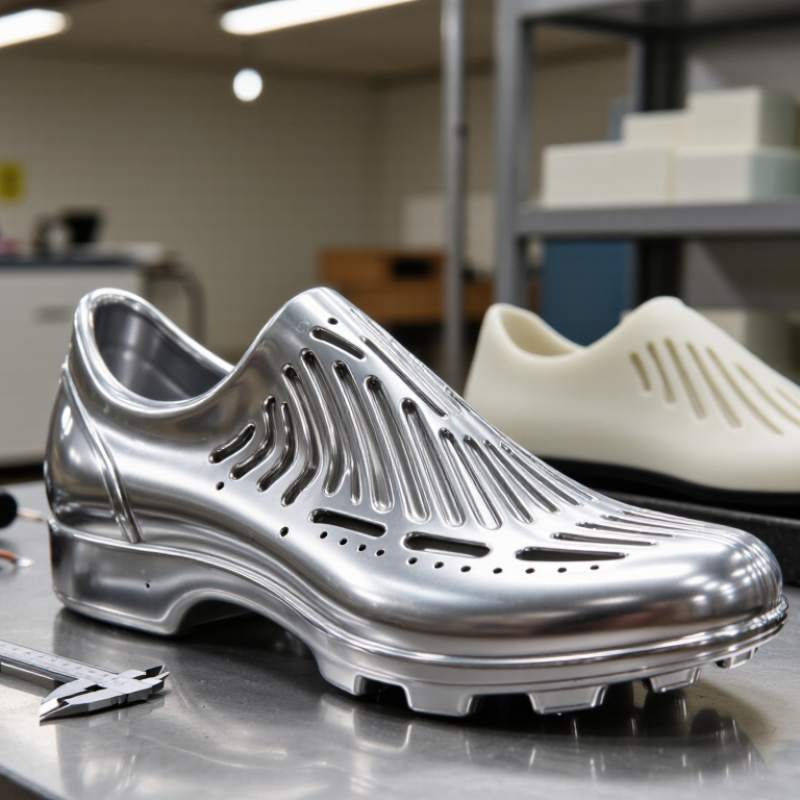
Understanding EVA shoe mould types starts with the finished product. Compression moulds suit midsoles, slippers, and simple outsole shapes. They offer flexible density control and relatively straightforward maintenance. Injection moulds work better for high-volume soles with detailed textures, consistent dimensions, and shorter cycle times. Direct injection systems can combine shaping and foaming, but they demand tighter control of temperature, pressure, and material expansion.
The application decides the mould structure. A soft running midsole may need deeper venting because trapped gas can create surface marks. A compact sandal sole may require sharper engraving and stronger edge support. Aluminium moulds usually provide faster heat transfer and easier machining. Steel moulds often resist repeated production better. The choice is not always obvious. A lower-cost mould can become expensive after repeated repairs.
The World Footwear Yearbook 2024 reported approximately 22.4 billion pairs of footwear produced globally in 2023, with Asia contributing about 88 percent. This scale increases demand for stable, repeatable EVA moulding. Industry production data from Grand View Research also identifies footwear as a major EVA application, supported by demand for lightweight and shock-absorbing products. Before ordering, test the intended EVA compound, expansion ratio, cavity balance, and cooling performance. Check real samples, not only drawings. Small errors remain surprisingly visible.
How to Choose an EVA Shoe Mould in 2026?
Defining Shoe Design, Size, and Production Requirements
Choosing an EVA shoe mould starts with the product brief, not the mould catalogue. Define the outsole profile, upper connection, target weight, cushioning level, and size range. A thick heel needs different cavity control from a lightweight beach sandal. EVA expands during moulding, so the compound’s density, expansion ratio, and shrinkage must be tested together. Small errors can change arch support and overall balance.
The 2024 World Footwear Yearbook recorded 23.9 billion pairs of footwear produced globally in 2023, with Asia supplying about 88%. This scale increases pressure on repeatable mould performance. Check cavity uniformity, vent placement, cooling paths, and release efficiency before approving production tooling. A mould that saves material but creates uneven cells is not economical. It only moves the cost downstream.
Allied Market Research estimated the global footwear market at 365.5 billion dollars in 2022, projecting 530.3 billion dollars by 2031. These forecasts differ by methodology, so treat them as planning signals, not guarantees. For sizing, test the smallest, middle, and largest sizes, including foot-length and width changes. A perfect-looking prototype can still fail after demoulding. The first design is rarely final. Keep one revision cycle for foam behavior, worker handling, and actual production speed.
| Selection Dimension | Typical Requirement | Recommended Mould Configuration | Key Technical Data | Production Impact | Practical Selection Guidance |
|---|---|---|---|---|---|
| Shoe Product Type | Slides, sandals, casual sneakers, running shoes, work shoes, or safety footwear | Match mould structure to product | One-piece sole, two-piece sole, or integrated upper-and-sole construction | Determines mould complexity, venting needs, demoulding method, and tooling cost | Use a simpler single-density mould for basic slides and a multi-part or integrated structure for detailed athletic footwear. |
| EVA Material Density | Lightweight cushioning or firmer structural support | Select cavity volume and pressure accordingly | Approximately 0.16–0.30 g/cm³ for common expanded EVA footwear components | Lower density requires better expansion control and more consistent venting | Confirm the material supplier’s expansion ratio before finalizing cavity dimensions and charge weight. |
| Foam Hardness | Soft comfort, balanced cushioning, or firm support | Design for target hardness | Common footwear range: approximately 35–70 Shore C | Hardness affects rebound, compression set, trimming behavior, and perceived comfort | Use test samples to verify hardness after conditioning because formulation, density, and curing temperature interact. |
| Size Range | Single size, a small size group, or a complete size run | Plan a size-specific tooling strategy | Typical adult size increments: 5–10 mm in inner-length grading | Each size normally requires its own cavity or accurately engineered interchangeable insert | Keep the last shape, toe spring, heel height, and allowance consistent across the size range. |
| Dimensional Shrinkage | Stable finished dimensions after expansion and cooling | Allow for material-specific compensation | Often about 1.0–3.0%, subject to formulation, density, cure cycle, and cooling conditions | Incorrect compensation can cause mismatch between sole, upper, insole, and outsole components | Measure production samples in three dimensions and establish the actual compensation factor before mass production. |
| Tread and Surface Detail | Plain outsole, geometric tread, deep traction pattern, or decorative texture | Use suitable draft and venting | Recommended draft commonly starts around 1°–3°, increasing for deep or textured features | Fine detail increases filling difficulty, cleaning requirements, and risk of incomplete replication | Avoid excessively sharp corners and narrow grooves; use radiused transitions to improve filling and demoulding. |
| Mould Material | Prototype validation, standard production, or high-volume manufacturing | Choose material by service life | Aluminium is common for lightweight tooling; steel is selected for higher wear resistance | Material affects thermal response, machining time, weight, durability, and maintenance cost | Use lightweight metal tooling for frequent design changes and harder-wearing tooling for long production runs or abrasive compounds. |
| Cavity Layout | Low-volume sampling or high-output production | Select single- or multi-cavity tooling | Common configurations include 1, 2, 4, 6, or 8 cavities, depending on machine capacity | More cavities improve output but increase balancing, tooling, loading, and maintenance requirements | Match cavity count with press platen size, heating capacity, operator workflow, and expected monthly demand. |
| Venting and Air Removal | Uniform filling with minimal air traps and surface marks | Add vents at high-risk areas | Vents are typically positioned near high points, deep grooves, corners, and the end of filling paths | Poor venting may create voids, incomplete tread detail, discoloration, or uneven density | Review vent locations during sampling and adjust them without weakening critical visual or structural surfaces. |
| Cycle Time | Fast output with repeatable expansion and curing | Balance heat transfer and cure requirements | Typical EVA moulding cycles may range from about 6–15 minutes, depending on thickness and formulation | Shorter cycles improve productivity but can increase under-cure, shrinkage variation, or dimensional instability | Set cycle time using part thickness, mould temperature, material formulation, and verified physical test results. |
| Mould Surface Finish | Glossy, matte, textured, or easy-release surface | Specify finish by visual and release needs | Surface roughness should be defined consistently across functional and cosmetic areas | Finish influences appearance, friction, release behavior, and the visibility of minor mould marks | Use a controlled texture for grip areas and a uniform cosmetic finish for visible sidewalls and branding-free design panels. |
| Production Volume | Prototype, seasonal production, or continuous high-volume output | Optimize for total lifecycle cost | Low-volume tooling prioritizes flexibility; high-volume tooling prioritizes durability and cycle consistency | Tooling investment should be evaluated against expected pairs, maintenance, changeovers, and replacement risk | For uncertain demand, begin with flexible tooling and validate the design before investing in larger multi-cavity systems. |
| Quality Control Points | Consistent size, weight, density, hardness, rebound, and appearance | Define measurable acceptance criteria | Recommended checks include length, width, thickness, mass, hardness, density, and visual defects | Clear inspection data reduces mould adjustments, batch variation, and assembly problems | Create a first-article approval standard and record process conditions for every tooling revision. |
Choosing an EVA shoe mould in 2026 requires more than comparing quotations. Material, structure, and machining precision directly affect foam flow, cooling, and repeated sizing. Aluminum remains practical for many EVA projects because it transfers heat quickly and machines easily. Steel offers stronger wear resistance, but it adds weight, machining time, and cost. For short production runs, aluminum may be sufficient. That judgment can fail when abrasive fillers or high-pressure cycles are involved.
Structure deserves closer inspection. A split mould needs accurate alignment around the parting line. Otherwise, flashing may appear along the outsole edge. Check cavity depth, vent locations, cooling channels, and insert replacement access. A mould with removable inserts can reduce repair downtime. It can also introduce alignment errors. Small details matter. The 2024 World Footwear Yearbook reported approximately 23.9 billion pairs produced globally in 2023. At that scale, inconsistent cavities quickly become expensive.
Manufacturing precision should be verified, not promised. Request a dimensional inspection report, cavity-to-cavity comparison, and trial samples from the actual tool. Measure heel height, sole length, and key wall thicknesses after foaming. CNC machining can improve repeatability, but thermal expansion and foam shrinkage still require compensation. EVA foam density and hardness may vary between batches. Grand View Research identifies continued growth in the EVA foam market through 2030, increasing pressure for stable tooling. In practice, a perfect drawing does not guarantee a perfect shoe. That uncomfortable gap deserves testing.
How to Choose an EVA Shoe Mould in 2026?
Evaluating Compatibility with EVA Molding Equipment
An EVA shoe mould must match the molding machine, not just the shoe design. Check the machine’s platen size, clamping force, injection capacity, and working stroke. A mould that fits the drawing may still exceed the equipment’s usable space. Leave room for hoses, heating lines, and safe operator access.
For compression molding, confirm the mould’s cavity depth and loading method. EVA compound needs enough space to expand during heating. For injection molding, review runner balance, gate position, venting, and shot volume. Poor venting can leave burned edges or incomplete textures. Cooling channels should follow thick areas, especially around the heel and sole waist. Uneven cooling may create warping after demoulding.
I have learned to test compatibility with a sample mould before full production. Measure the closed height with a gauge, then check the machine’s actual pressure stability. Do not rely only on old equipment specifications. Real conditions can differ. I once overlooked a narrow service gap, and changing the mould frame became necessary. That mistake was avoidable.
Ask the mould maker for steel data, thermal limits, maintenance requirements, and dimensional tolerances. Confirm whether the equipment supports the planned EVA density and expansion ratio. A small trial should record cycle time, mould temperature, flash, shrinkage, and release behavior. These records support reliable decisions, although one trial may not reveal every production problem.
Evaluating Compatibility with EVA Molding Equipment
The chart shows the percentage of a reference molding machine’s available capacity used by a selected EVA shoe mould. Lower utilization leaves more operating margin for thermal expansion, flash control, mould changes, and production variation. Always confirm the exact platen size, mould thickness, clamping force, injection volume, and ejector stroke with the equipment specification.
A reliable EVA shoe mould starts with dimensional accuracy, not a polished sales sample. Check cavity balance, shrinkage control, vent placement, and surface finishing. The World Footwear 2024 Yearbook recorded about 23.9 billion pairs produced globally in 2023. At that scale, a tiny mould error can multiply into thousands of rejected soles. Request trial samples from several production cycles. Measure length, width, weight, hardness, and logo alignment. Ask for evidence.
Cost requires a wider calculation. Compare the mould price, machining tolerance, delivery time, repair terms, and expected cycle life. A cheaper mould may demand frequent polishing or produce unstable foam expansion. Industry reports from Grand View Research place the global ethylene-vinyl acetate market on a steady growth path through 2030, increasing pressure on material efficiency and production consistency. Do not accept a projected saving without scrap data. My own checklist would include electricity use and operator time, although these costs are often overlooked.
Maintenance should be practical. Confirm access to vents, replaceable inserts, anti-corrosion treatment, and documented cleaning intervals. Supplier reliability needs proof, not confident promises. Check engineering drawings, inspection records, response times, and backup machining capacity. Require a written tolerance range and a sample approval process. Call one previous customer, if possible. A perfect first trial can mislead. Real production exposes weak cooling channels, uneven texture, and delayed technical support. Reliability is tested later.
Thank you for reaching out.
Your message has been received, and a member of the Bluestem Energy Solutions team will be in touch soon. We appreciate your interest and look forward to connecting.
