What Are CNC Cutting Tools and How Do They Work?
Cnc Cutting Tools are the working edges behind modern precision manufacturing. They remove material from metal, plastic, composites, and other engineering materials. A rotating end mill, drill, reamer, or turning insert follows programmed toolpaths. Its cutting edge shears away controlled chips while the machine manages speed, feed, and depth.
Small details matter.
Tool geometry affects chip flow, surface finish, vibration, and tool life. Carbide tools commonly handle demanding production work because they combine hardness with useful heat resistance. High-speed steel remains practical for certain drills and lower-speed operations. Ceramic and diamond-based tools serve more specialized applications, including hardened alloys and abrasive non-ferrous materials.
Industry data supports this growing importance. The U.S. Cutting Tool Institute and AMT publish monthly U.S. Cutting Tool Consumption Reports, tracking demand across manufacturing sectors. These reports connect cutting-tool consumption with activity in automotive, aerospace, machinery, and other industrial markets. Global market analyses from Grand View Research and MarketsandMarkets also describe expanding CNC equipment and tooling demand, driven by automation, tighter tolerances, and shorter production cycles. Exact market values differ between reports, partly because researchers define “cutting tools” differently.
That limitation deserves attention.
A tool is not automatically productive because it cuts quickly. Poor workholding, incorrect coolant, or excessive radial engagement can destroy an edge within minutes. Experienced machinists therefore read chips, inspect flank wear, and compare actual results with manufacturer recommendations. This guide explains how Cnc Cutting Tools work, how their materials and geometries differ, and how those choices influence accuracy, cost, safety, and repeatable production.
CNC Cutting Tools: Types, Materials, and ISO 13399 Tool Data
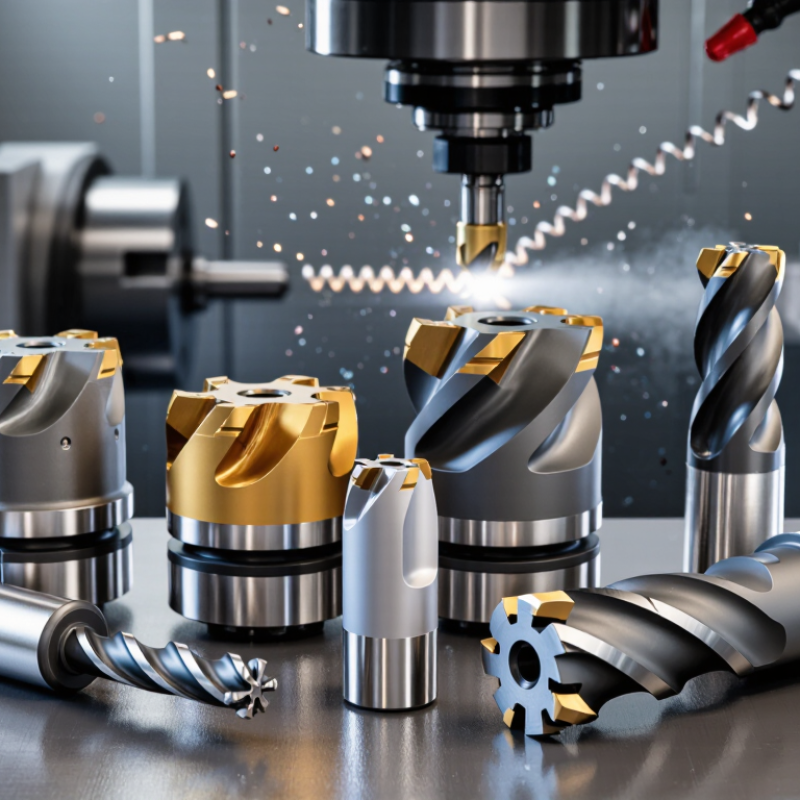
CNC cutting tools convert programmed motion into controlled material removal. A spindle rotates the tool, while feed motion guides it through the workpiece. End mills create slots, pockets, and contours. Drills produce accurate holes. Face mills remove broad layers from flat surfaces. Turning inserts cut rotating bars on a lathe. Short tools matter. They reduce vibration.
Tool material strongly affects cutting behavior. Cemented carbide handles higher cutting speeds than high-speed steel and stays rigid during demanding cuts. Ceramic and cubic boron nitride suit selected heat-resistant or hardened materials. Diamond tools can provide excellent wear resistance when cutting suitable non-ferrous materials. Coatings may reduce friction and protect the cutting edge. However, a harder tool is not automatically better. Coolant, chip evacuation, machine rigidity, and workpiece hardness still decide performance. A 10 mm carbide end mill can fail quickly when chips remain trapped in a deep pocket.
ISO 13399 gives cutting-tool data a common digital structure. It describes properties such as tool type, cutting diameter, usable length, insert geometry, and handedness. CAM systems and tool-management software can exchange this information more consistently. The standard improves identification, but it does not guarantee a perfect cutting result. Data may be incomplete, outdated, or entered incorrectly. I have seen small length errors cause serious collisions. Verify tool assemblies, offsets, and measured dimensions at the machine. Treat digital data as a reliable starting point, not unquestionable truth.
How Tool Geometry Controls Cutting Speed, Feed, and Chip Formation
CNC cutting tools remove metal through controlled contact between the edge and the workpiece. Tool geometry decides how that contact behaves. Rake angle guides chip flow and lowers cutting resistance. A larger positive rake can reduce heat, but it may weaken the edge. A smaller rake improves strength during interrupted cuts. The choice is never automatic.
Cutting speed depends on tool diameter and spindle speed: Vc = πDn/1000. Feed rate depends on tooth count, spindle speed, and feed per tooth. Helix angle influences chip evacuation, especially in pockets and narrow slots. Clearance angle prevents rubbing against the machined surface. Too much clearance weakens support behind the edge. Small details matter.
The 2023 U.S. Cutting Tool Consumption Report from USCTI and AMT recorded roughly 2.4 billion dollars in industry consumption. That scale reflects how closely tool selection affects production costs. ISO 3685 commonly uses 0.3 millimeters of flank wear during standardized tool-life testing. In practice, operators should still inspect chips, sound, and surface finish. I have seen a theoretically correct feed rate fail when chips packed inside a deep cavity. The calculation was fine. The geometry was not. A more open helix, adjusted coolant direction, or lower radial engagement may solve the problem. Sometimes, the original setup simply needs questioning.
The CNC Cutting Cycle: 10,000–30,000 RPM Spindle Motion Explained
CNC cutting tools remove material through controlled rotation and programmed movement. Common examples include end mills, drills, face mills, and turning inserts. The spindle holds the tool, while servo motors guide it along precise X, Y, and Z paths. A 10,000–30,000 RPM cycle may look simple, but every second affects heat, vibration, and tool life.
At 20,000 RPM, a 10 mm cutter reaches about 628 meters per minute at its edge. The calculation uses cutting speed = π × tool diameter × RPM. Feed rate must match tooth count and chip load. Too little chip load creates rubbing, not cutting. Too much can break the edge. Short accelerations matter, too. The machine must reach speed before full engagement. Otherwise, the first corner may suffer.
Energy also deserves attention. The U.S. Department of Energy estimates motor-driven systems consume roughly 70% of electricity used in industrial facilities. CNC spindles are only one part of that load, yet high-speed motion can raise demand sharply. ISO 230 standards emphasize geometric accuracy, positioning behavior, and repeatable testing. In real workshops, however, coolant temperature, tool runout, and material hardness complicate neat calculations. A 12,000 RPM setting may work beautifully in aluminum but fail in hardened steel. The numbers are useful, not sacred. Experienced operators still listen for a sharp cutting sound, inspect chips, and adjust cautiously. Sometimes the programmed cycle is technically correct, but practically wrong.
Carbide, HSS, and Diamond Tools: Hardness Above 90 HRA Compared
What Are CNC Cutting Tools and How Do They Work?
CNC cutting tools remove material through controlled rotation, feed, and depth of cut. Their performance depends heavily on hardness, toughness, and heat resistance. Hardness above 90 HRA sounds decisive, but the comparison is not that simple.
Carbide inserts commonly measure about 88–94 HRA, making them effective for steel, cast iron, and interrupted cuts. The 2024 U.S. Geological Survey Mineral Commodity Summaries reported roughly 81,000 metric tons of global tungsten mine production in 2023. Tungsten carbide relies on this dense, wear-resistant material. It supports high cutting speeds, although brittle edges can chip under vibration.
High-speed steel usually has lower hardness, often around 60–70 HRC after heat treatment. It sacrifices hardness for toughness and easier reshaping. That makes it useful for drills, taps, and unstable machining setups. Diamond is far harder than carbide and ranks near 10 on the Mohs scale. However, HRA is not the correct routine scale for diamond. Direct conversion can mislead engineers.
ISO 513 classifies cutting-tool materials by properties and applications, while ASTM E18 defines Rockwell hardness testing methods. These standards remind users to compare like with like. In a shop, a diamond tool may excel on abrasive composites but fail against ferrous materials because of chemical wear. Carbide often offers the safer balance. Not always. Clearance, coolant, vibration, and edge geometry can reverse the expected result. A harder tool is not automatically a better tool.
What Are CNC Cutting Tools and How Do They Work?
Carbide, HSS, and Diamond Tools Compared by Typical Hardness
The chart compares representative hardness on the Mohs scale. HSS is tough and economical for lower cutting speeds, cemented carbide is harder and supports higher speeds, and diamond provides the highest hardness for suitable non-ferrous and abrasive materials. Cemented carbide grades may exceed 90 HRA, but diamond is not directly or reliably expressed on the Rockwell A scale, so Mohs hardness is used here for a consistent comparison. Actual performance depends on tool grade, coating, workpiece material, cutting speed, feed, and temperature.
Tool Wear, 0.01 mm Accuracy, and Data-Driven Replacement Decisions
What Are CNC Cutting Tools and How Do They Work?
Tool Wear, 0.01 mm Accuracy, and Data-Driven Replacement Decisions
CNC cutting tools remove material through controlled rotation, pressure, and programmed movement. Their edges face heat, vibration, and repeated mechanical shock. Even a small flank-wear mark can change surface finish and dimensional accuracy. ISO 3685 provides standardized methods for evaluating tool life, but factory conditions remain different. Coolant flow, workpiece hardness, and machine rigidity can alter results.
A 0.01 mm tolerance demands more than a sharp insert. Thermal drift, spindle runout, fixture movement, and measurement uncertainty all matter. ISO 230-2 highlights the importance of machine positioning accuracy during verification. Operators should compare tool offset changes with measured part dimensions. Watch the trend, not one alarming reading. A single bad measurement can mislead replacement decisions.
The 2022 Global Smart Manufacturing Survey reported that 86% of manufacturers viewed smart-factory programs as important to future competitiveness. That data supports condition-based tool management. Sensors can record cutting force, spindle load, vibration, cycle time, and surface results. A replacement model can then combine wear limits with production history. It should not replace human judgment completely. Our first rule may be too conservative. Replacing tools early wastes usable edge life, while waiting too long risks scrap and unstable cuts. A practical threshold might use 0.01 mm dimensional drift, rising spindle load, and repeated surface defects together. Calibration records must remain visible, or the algorithm only produces precise-looking guesses.