How to Find the Best Air Door Supplier in China?
Choosing an Air Door supplier in China is not just a matter of comparing prices. The right unit should fit the doorway, traffic level, climate, and building layout. A supermarket entrance with frequent trolley traffic has different needs from a small restaurant doorway. Details matter. A poorly matched unit may create noise, uneven airflow, or higher operating costs.
A reliable supplier should explain how its Air Door models are selected and tested. Ask for airflow data, dimensions, motor specifications, noise information, and installation guidance. Request product drawings and clear answers about warranty coverage, spare parts, and lead times. Ask for proof. Product photos are useful, but they cannot confirm performance on their own. A sample, a factory video call, or a detailed test report can help you assess the supplier more carefully.
This guide covers practical ways to compare manufacturers, verify product claims, and communicate your requirements before placing an order. It also looks at details buyers can overlook, including voltage compatibility, packaging, and after-sales support. A low quotation may seem attractive. Yet unclear specifications can lead to delays or costly changes later. No checklist removes every risk, and supplier information still needs careful review. Use the steps here to ask better questions and choose an Air Door supplier whose products and service match your project.
Define Doorway Requirements by Width, Height, Traffic, and Climate
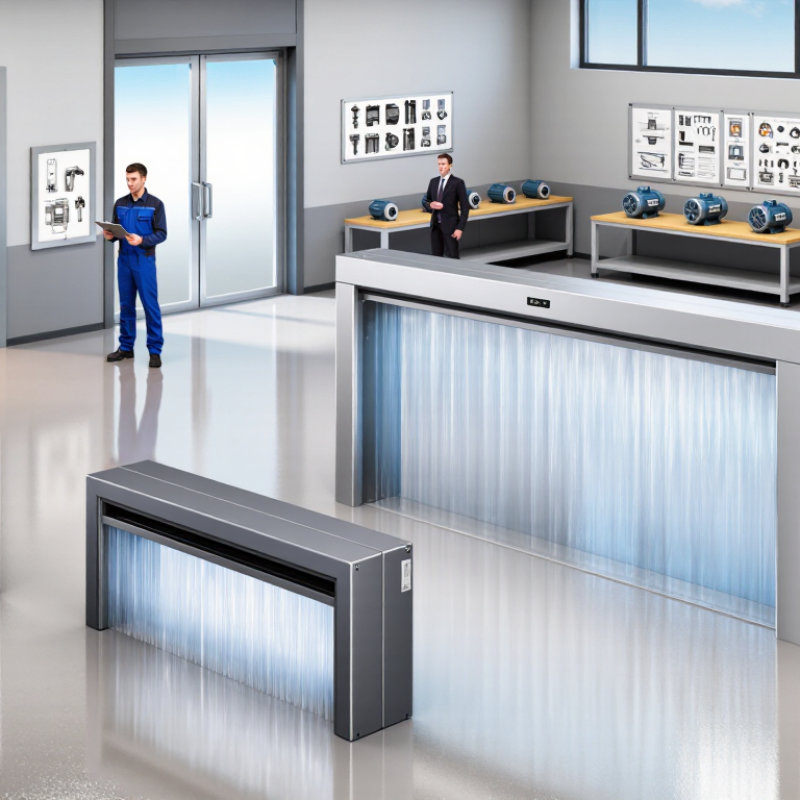
A suitable air door starts with accurate doorway measurements. Record the clear opening width and height, not the surrounding frame dimensions. Note beams, signs, and pipes above the entrance; they can limit mounting space. For a wide loading bay, one unit may not deliver even airflow across the full opening. Ask suppliers how they size units for your exact opening and whether their recommendations include installation conditions.
Traffic matters as much as size. A staff entrance that opens occasionally has different needs from a busy warehouse door used by forklifts every few minutes. Share typical opening frequency, door-open duration, and vehicle movement with potential suppliers. Climate also changes the specification. In a cold region, ask about airflow performance and heat loss; in humid or dusty settings, discuss corrosion resistance and cleaning access. Request test data or clear performance criteria, rather than relying only on broad claims. Real sites are messy.
Tips: Measure the doorway at several points, since floors and lintels may not be level. Photograph the entrance and note nearby obstacles. Ask suppliers to explain their assumptions in writing, including mounting height, operating conditions, and maintenance needs. If your traffic or climate data is incomplete, say so; an estimate built on guesses can miss the mark. It is worth checking the proposed airflow direction on site before ordering.
Compare Airflow (m³/h), Outlet Velocity (m/s), and Noise (dB(A))
When comparing air door suppliers in China, request airflow in m³/h and outlet velocity in m/s under clearly stated test conditions. AMCA Publication 220 sets standardized test methods for air curtain units, helping buyers compare measured performance rather than brochure claims. Ask where velocity was measured: at the nozzle, or farther below it? A reading of 10 m/s at the outlet does not guarantee the same speed across a wide doorway. Check the unit’s width, mounting height, and operating speed against your actual opening. Small differences matter.
Noise needs equal scrutiny. Request dB(A) readings with the measurement distance, fan speed, and room conditions stated. A bare “low noise” claim is not useful. NIOSH’s Criteria for a Recommended Standard recommends an occupational exposure limit of 85 dB(A) over eight hours; this is workplace guidance, not a product acceptance threshold. Compare supplier readings at matching distances, since sound levels can change substantially with measurement position. Ask for the test report, not just a catalog figure. I still double-check this. Airflow, velocity, and noise should describe the same operating setting; otherwise, the quietest rating may not reflect the setting needed at your entrance.
Verify Performance Testing Against ANSI/AMCA 220-05 (R2012)
How to Find the Best Air Door Supplier in China?
Verify Performance Testing Against ANSI/AMCA 220-05 (R2012)
A polished brochure is not performance evidence. Ask for the complete laboratory report, tested under ANSI/AMCA 220-05 (R2012), “Laboratory Methods of Testing Air Curtains for Aerodynamic Performance Rating.” This standard provides a consistent method for evaluating aerodynamic performance. Check that the report identifies the exact model, test setup, and operating conditions—not merely a product family.
Look closely at the measured discharge-velocity profile and airflow data. Ask for readings across the outlet, not one impressive peak value. A useful report lets you compare velocity distribution, airflow, and electrical input at the stated fan setting. Keep the units visible: feet per minute, cubic feet per minute, and watts. Small details matter. If the supplier shares only a certificate or a single headline figure, request the underlying tables and test date.
Then match the results to your doorway’s width, height, and exposure to drafts. A strong laboratory result does not guarantee the same performance in a windy entrance. I have seen this distinction overlooked; it is easy to do. Ask whether the tested configuration matches the unit being quoted, including nozzle angle and installation height. The AMCA method supports fairer comparisons, but it cannot replace a site-specific review. Be cautious of claims that omit test conditions or imply one rating suits every opening.
Check Quality Systems Against ISO 9001:2015 and Review Factory Records
An ISO 9001:2015 certificate is a useful starting point, not proof that every air door will perform consistently. Check that the certificate is current and covers the factory’s relevant manufacturing activities. Ask who issued it and whether the factory can explain how its quality procedures work on the production floor. Paperwork alone is not enough.
Review records from recent production batches, including incoming material checks, assembly inspections, and final performance tests. For an air door, look for documented checks on airflow, electrical safety, noise, and operating controls. Ask how instruments are calibrated and how failed units are recorded and corrected. A supplier should be able to trace a finished unit back to its inspection results and key components. Look closely.
It is easy to overvalue neat documents. Compare dates, batch numbers, and signatures across several records, then ask staff to explain any gaps. A missing entry does not automatically prove poor quality, but vague answers deserve attention. Request a sample report and see whether its measurements, acceptance limits, and corrective actions are clear. One visit cannot reveal everything, so verify records against the actual process and the air door model you plan to buy.
Compare Warranty, Spare-Parts Lead Times, and Total Cost of Ownership
A low purchase price can hide expensive service gaps. Compare warranty length, covered components, labor, and shipping separately; “five years” may cover only the motor, not controls or installation. Ask suppliers to quote lead times for motors, circuit boards, and filters, then confirm whether parts are stocked in China or made to order. A promised dispatch date is not the same as delivery at your loading dock. Small detail. It matters.
Spare-parts delays can turn a minor fault into a doorway left unprotected during busy shifts. Request recent, anonymized service records showing typical response and dispatch times. The U.S. Energy Information Administration’s 2018 Commercial Buildings Energy Consumption Survey reported that space heating accounted for 32% of commercial-building site energy use. That makes air leakage worth checking, but savings depend on door traffic, climate, and installation—not a sales estimate alone.
Build a five-year ownership comparison: purchase and installation, electricity, planned maintenance, replacement parts, and likely downtime. The U.S. Department of Energy’s Federal Energy Management Program life-cycle-cost guidance likewise considers costs beyond the initial purchase. Ask each supplier to state assumptions, such as daily operating hours and local electricity rates. A spreadsheet can still mislead. I would leave an allowance for unplanned service; real sites rarely behave as neatly as quotes do.