
How to Choose the Best Conical Burr Hand Grinder
Choosing a hand grinder can feel simple until you compare burr shapes, adjustment systems, and build quality. A Conical Burr Hand Grinder uses cone-shaped burrs to break coffee beans into smaller particles. Its results depend on more than the burr design. Burr alignment, adjustment precision, and steady grinding technique all matter.
Think about how you brew. For pour-over, you may want repeatable settings and a grind adjustment that is easy to fine-tune. For French press, a consistent coarse setting can help limit excess sediment. Espresso is more demanding. Not every manual grinder can make the small, precise adjustments it requires. Check the manufacturer’s guidance rather than assuming one grinder suits every method.
Feel matters, too. A textured handle, a stable body, and a comfortable grip make a difference during a slow morning grind. Small details count. Capacity may matter if you regularly brew for several people, while compact dimensions help when storage space is tight. Stainless steel burrs are common, but material alone does not guarantee better coffee. Look for clear specifications, replacement-part availability, and credible reviews that discuss real use.
There is no perfect choice. A premium model may feel reassuring, yet its weight or price might not suit your routine. I would also question reviews that promise dramatically sweeter coffee without explaining the beans or brewing method. Taste is personal. A good Conical Burr Hand Grinder should offer dependable adjustment, practical construction, and a workflow you will actually enjoy. That last part is easy to overlook.
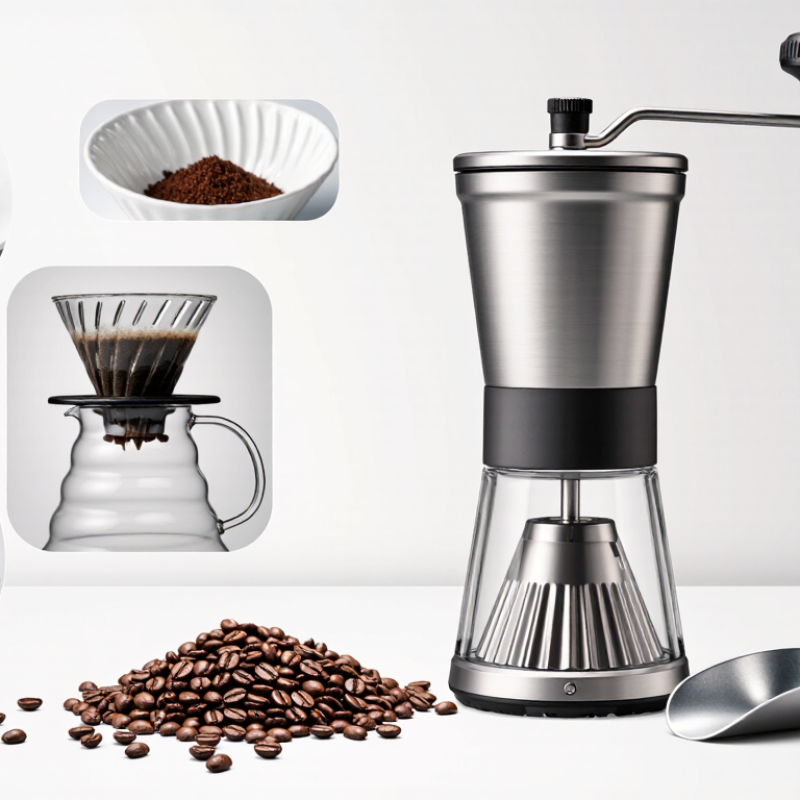
How Conical Burr Hand Grinders Work
How to Choose the Best Conical Burr Hand Grinder
How Conical Burr Hand Grinders Work
A conical burr hand grinder uses two ridged surfaces: a cone-shaped burr inside a surrounding ring. Turning the crank rotates the inner burr, drawing beans downward and cutting them into smaller particles. The gap between the burrs sets the grind size; a narrower gap usually creates finer grounds. Unlike blade chopping, burr grinding aims for more consistent particles, though no grinder produces perfectly uniform grounds. You can feel the difference as the crank turns: beans begin firm, then give way with a dry, gritty sound.
Particle consistency matters because water extracts flavor from grounds at different rates. The Specialty Coffee Association’s Golden Cup recommendations place brewed coffee extraction yield around 18–22%, alongside a target beverage strength of 1.15–1.35% total dissolved solids. These are brewing benchmarks, not a guarantee that every grinder or recipe will taste right. A hand grinder’s adjustment steps, burr alignment, and your turning speed all affect results. Small changes can matter.
Tips: Set the grind while the grinder is empty, then test a small dose. If the handle catches, avoid forcing it; coarse beans or a clogged chamber may be the cause. Keep the burrs dry and brush away fine residue. One thing worth reconsidering: “finer” does not always mean “better”—taste the cup before changing the setting.
How to Choose the Best Conical Burr Hand Grinder - How Conical Burr Hand Grinders Work
| Dimension | How It Works | What to Look For | Practical Trade-Off |
|---|---|---|---|
| Conical burr mechanism | A rotating cone-shaped burr sits inside a stationary outer burr. Beans are drawn between the burrs and broken into smaller particles as they move toward the outlet. | Look for burrs that are firmly supported and aligned, with a grind adjustment that remains consistent during use. | Burr geometry, alignment, and adjustment design all affect results; the conical shape alone does not guarantee a particular grind quality. |
| Grind adjustment | Changing the distance between the burrs changes the average particle size. Finer settings use a smaller gap; coarser settings use a larger one. | Choose clear, repeatable settings with enough range for your preferred brewing methods. Fine adjustment can help when dialing in espresso. | Stepped settings are easy to repeat, while stepless adjustment offers more control but can be harder to reproduce. |
| Burr material | Hand grinders commonly use stainless-steel or ceramic burrs to crush and shear beans. | Check for durable construction, replaceable parts, and straightforward cleaning instructions. | Material alone does not determine grind consistency. Burr geometry, manufacturing quality, and alignment also matter. |
| Grind consistency | Burrs produce a distribution of particle sizes rather than particles that are all exactly identical. | For a pour-over or immersion brew, prioritize even grinding and dependable adjustment. For espresso, look for finer control and a suitable fine-grind range. | Different brew methods tolerate different particle distributions; taste and extraction depend on the grinder, coffee, and brewing technique together. |
| Crank and handle | Turning the crank rotates the inner burr. Handle length and grip shape influence leverage and comfort. | Choose a secure handle that feels comfortable through repeated turns, especially if you regularly grind fine or larger doses. | A longer handle can provide more leverage but may make the grinder less compact to pack. |
| Capacity and portability | Beans are loaded into the hopper, and ground coffee collects in a removable chamber or cup. | Match the capacity to your usual dose and check the grinder's packed size and weight if you travel with it. | A larger capacity can reduce the need to grind in batches, while a smaller body is generally easier to carry. |
| Cleaning and maintenance | Ground coffee and oils can collect around the burrs and in the grounds chamber over time. | Prefer a design that can be disassembled and brushed according to its instructions, without requiring complicated tools. | Regular dry cleaning helps keep residue from building up; avoid washing burrs or parts unless the manufacturer says they are washable. |
| Best-use match | Manual grinders use hand power rather than an electric motor, so grinding time and effort depend on dose, setting, and grinder design. | Choose a compact, easy-to-adjust model for travel or occasional brewing; prioritize comfortable operation and fine adjustment for frequent espresso preparation. | Manual grinding is portable and does not need electricity, but it requires physical effort for each dose. |
Buying tip: Compare adjustment range, comfort, capacity, and cleaning access together. Performance and stated capacities vary by grinder design.