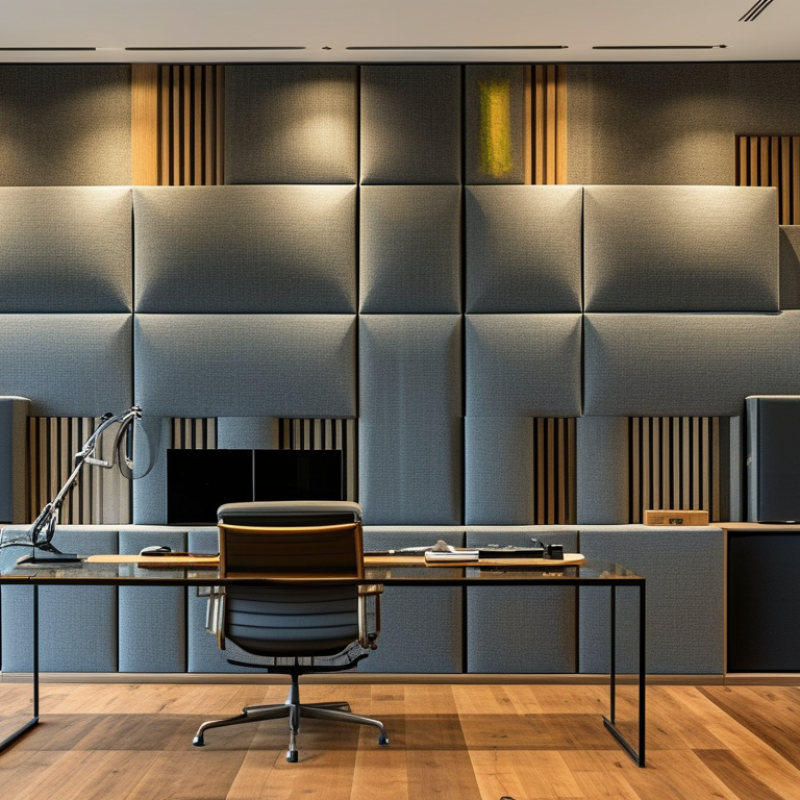
| Primary Acoustic Function | Sound absorption rather than true sound isolation | Porous panels reduce reflected sound energy inside a room. They help control reverberation, flutter echo, and excessive brightness, but they do not create a fully soundproof barrier. | Offices, studios, classrooms, meeting rooms, home theaters, and media rooms |
| Typical Panel Thickness | 25–50 mm (approximately 1–2 in) | Thicker absorbers generally provide better absorption at lower and mid frequencies than very thin panels, provided the core material and covering are acoustically suitable. | General speech, music, video calls, and room-echo control |
| Optional Air Gap | 25–100 mm behind the panel | Spacing a porous panel away from the wall can improve low-frequency absorption by allowing particle velocity to develop behind the absorber. | Rooms requiring broader frequency control without substantially increasing panel thickness |
| Typical Absorption Performance | NRC commonly ranges from about 0.45 to 0.95, depending on construction | The Noise Reduction Coefficient is a rounded average of absorption coefficients at 250, 500, 1,000, and 2,000 Hz. Higher values indicate greater average absorption in these mid-frequency bands. | Comparing similar panels for speech and general room reverberation control |
| Frequency Coverage | Strongest effect usually in mid and high frequencies; low-frequency performance varies | Panel thickness, density, mounting distance, edge exposure, and room conditions affect frequency response. Bass problems often require thicker absorbers, corner treatment, or dedicated low-frequency solutions. | Use with bass traps or thicker treatment when the room has strong low-frequency buildup |
| Reverberation Control | Can reduce reflected energy and measured reverberation time when sufficient surface area is installed | Reducing repeated reflections improves speech intelligibility, recording clarity, listening comfort, and perceived room focus. | Large, hard-surfaced rooms with noticeable echo or poor speech clarity |
| Recommended Coverage Approach | Begin with approximately 15–30% of relevant wall or ceiling area, then adjust after listening or measurement | The required area depends on room volume, existing finishes, occupancy, panel absorption, and the desired reverberation time. More coverage is not always better if a natural sound balance is preferred. | Planning an initial treatment layout for offices, studios, and residential rooms |
| Modular Design Benefit | Panels can be arranged, removed, replaced, or repositioned individually | A modular layout makes it easier to target first-reflection points, adjust room balance, change the visual arrangement, or relocate the treatment to another room. | Rental properties, flexible workspaces, multipurpose rooms, and evolving studio setups |
| DIY Installation | Common methods include cleats, impaling clips, removable adhesive, hooks, or freestanding frames | DIY installation can reduce labor requirements and support precise placement. The selected fixing method should match the panel weight, wall structure, and whether the installation must be reversible. | Projects where installation flexibility, cost control, or minimal construction work is important |
| Placement at First Reflection Points | Often placed on side walls, rear walls, ceilings, and other major reflection paths | Treating early reflections can reduce comb filtering and improve stereo imaging, vocal clarity, and perceived definition. A mirror method can help locate side-wall reflection points. | Recording rooms, listening rooms, home theaters, and video-conferencing spaces |
| Visual and Layout Flexibility | Available in multiple shapes, colors, orientations, and spacing patterns | Panels can combine acoustic treatment with interior design. Leaving calculated gaps between panels can increase effective coverage while creating a lighter visual appearance. | Design-conscious offices, hospitality areas, classrooms, and residential interiors |
| Sound Isolation Limitation | Does not normally stop voices, traffic, or music from passing through walls | Sound isolation requires mass, airtight construction, structural separation, and often decoupled wall or ceiling assemblies. Acoustic panels mainly improve sound inside the treated room. | Use alongside building-envelope upgrades when outside-noise reduction is required |
| Safety and Material Checks | Review fire performance, fiber containment, mounting security, and indoor-air-quality documentation | The panel covering should remain intact, the core should not shed particles, and installation should comply with local building and fire-safety requirements. | Commercial buildings, public spaces, educational facilities, and high-occupancy rooms |
| How to Verify Results | Compare before-and-after reverberation time, speech clarity, or calibrated room measurements | Subjective listening is useful, but measurements provide more reliable evidence of improvement. Test the room after installation and refine panel position or coverage if necessary. | Performance-focused installations and rooms with demanding acoustic targets |
| Technical note: Acoustic performance depends on panel construction, mounting method, room size, surface coverage, frequency range, and installation quality. NRC values are useful for comparison but should not be treated as a complete description of low-frequency absorption or sound isolation. |